
An oath of office is a defining ritual of American governance, taken by the president, cabinet members, judges, military officers, and other federal officials. While the presidential oath is prescribed by the Constitution, appointees take a broader federal oath that includes the phrase “I take this obligation freely without any mental reservation…,” emphasizing a full and voluntary commitment to duty.
As the oath for appointed officials was not proscribed by the Constitution, it has undergone a series of changes, some enduring, and some not. Why does the oath for appointed officials differ from the presidential oath, and why has it been changed from its original form?
Washington’s Oath of Office
Oaths carry deep historical significance, reflecting the solemn responsibility of public service. Looking back to the first inauguration, that of George Washington in 1789 at Federal Hall in New York City – then the Capitol of the nascent country – he set the precedent for all future presidents. Yet his well-documented reluctance to assume the presidency added a layer of meaning to the words he then spoke.
His oath, prescribed by the Constitution in Article II, Section 1, Clause 8, read:
“I do solemnly swear that I will faithfully execute the Office of President of the United States, and will to the best of my Ability, preserve, protect and defend the Constitution of the United States.”
Tradition holds that Washington added the phrase “so help me God” at the end, though historical evidence for this claim is debated. The phrase “or affirm” is included in the Constitution to accommodate individuals, such as Quakers, who had religious objections to swearing oaths. Franklin Pierce is the only president documented to have used the word “affirm” in place of “swear.” The two Quaker presidents, for whom swearing rather than affirming would have posed a challenge to their faith – Herbert Hoover and Richard Nixon – did not affirm but swore.
The continuity of the presidential oath underscores the enduring nature of the presidency and its constitutional foundation, while the evolution of the federal oath reflects the historical reality of changeable public and private loyalties.
Presidential Oath vs Other Oaths of Office
While the presidential oath has remained unchanged, other government officials—including cabinet members, judges, and military officers—take a different oath not found in the Constitution, and that has evolved with American history. Its earliest form was a simple declaration, codified by the Senate in May 1789:
“I do solemnly swear that I will support the Constitution of the United States.”
Today, the oath now reads:
“I, [name], do solemnly swear (or affirm) that I will support and defend the Constitution of the United States against all enemies, foreign and domestic; that I will bear true faith and allegiance to the same; that I take this obligation freely, without any mental reservation or purpose of evasion; and that I will well and faithfully discharge the duties of the office on which I am about to enter. So help me God.”
The Oath of Office and the Civil War
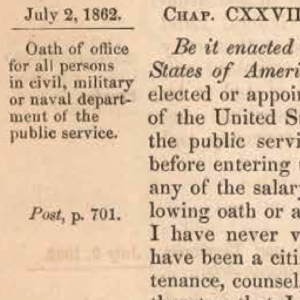
Nearly every year, barely detectable amendments are made to the language that to the layman appears inconsequential. Perhaps the most interesting chapter in the federal oath’s history occurred during the Civil War. Known as the “Ironclad Test Oath,” federal officials, whether civilian or military, were required to swear or affirm that they had never assisted individuals in armed hostility towards the United States.
Naturally, this meant that after the Civil War ended in 1865, federal officials such as senators who were from the south and who had fought against the Union could not include this clause in the oath and were sworn in without it, whereas their northern counterparts could. The requirement for the northern senators to take a harsher oath led to feelings of resentment and inequality that continuously resurfaced, causing the Ironclad Test Oath to be repealed in 1884.
The continuity of the presidential oath underscores the enduring nature of the presidency and its constitutional foundation, while the evolution of the federal oath reflects the historical reality of changeable public and private loyalties. Despite the constant amendments to the oath of office and the more drastic chapters in its history, the oath of office remains not only a defining ritual of American governance but a consistent one. In that sense, the oaths of office bind public servants not only to the law and to the American people but to past, present, and future public servants.