Quick Reference
Background
“War” said Clausewitz, who literally wrote the book, “is the province of chance. In no sphere of human activity is such a margin to be left for this intruder, because none is so much in constant contact with him on all sides.” It was luck, then, that General Thomas “Stonewall” Jackson was, on the night of his greatest military victory, at Chancellorsville. shot in the arm by friendly fire. Luck that his wounded left arm was amputated – causing his commander, Robert E. Lee, to say, “he has lost his left arm but I my right." And luck, which when bad is superstitiously believed to come in threes, that Jackson died of infection eight days later. “It is a terrible loss,” Robert E. Lee declared, “I do not know how to replace him.” Jackson was in fact irreplaceable - and his unlucky loss, still posited a portent of the Confederacy’s demise.
But Clausewitz on luck, as On War, might well mean something quite different to the foot soldier – say, at Chancellorsville - facing horrific battlefield conditions and staggering causalities. To those fighting in the mud and smoke of that battle, beset by swarms of insects in heavy woods and dense undergrowth, maxims about luck would probably have seemed simply antithetical: live or die. Yet for 22 year old Jewish Sergeant Major Eugene P. Jacobson of the 74th New York Infantry, on the night of May 2, 1863. the saying “One man's loss is another man's gain” would come to define his life…
After the day’s celebrated flank assault, and subsequent Union rout, General “Stonewall” Jackson and members of his staff rode in front of their lines to inspect the lines and reconnoiter for a possible night attack. In the dark, Jackson’s party was fired upon by his own troops and Jackson himself wounded in his arm. But even as the victorious general was scouting, he was being scouted, as Eugene Jacobson wrote in 1865:
On the night of the 2nd of May 1863, at the battle of Chancellorsville, when the 2nd Division of the 3rd Corps (to which I belonged) was ordered to take the position disgracefully abandoned by the 11th Corps, Major General Geary commanding the Division, found it impossible, on arrival to the position, to ascertain the exact whereabouts of the enemy. Squads and single stragglers belonging to the 11th Corps were continually crowding through our lines. Our troops were being fired upon from the front and responded briskly to the fire. It was impossible to know whether we were engaging the enemy or whether our own troops, being lost in the woods, were mistaking us for the enemy. In this dilemma General Geary called for volunteers to penetrate the woods between the combatting sections and to the troops confronting us, in order to ascertain their exact position as well as their colors. Five men beside myself volunteered for the duty, and I was put in charge of the expedition. I advanced my men under a heavy fire from both the front and rear to about ten yards of the enemy’s line. (for such I recognized it to be), and gliding silently on hands and feet along their line of battle for a distance of about one quarter of a mile, I ascertained the precise position and returned, without the loss of a man or without, apparently, having been discovered, to our own lines under a heavy fire from our pickets. The information which I was enabled to furnish General Geary empowered him to station our Division in a manner to fill up the extent of the line so unwarrantably abandoned by the whole of the 11th Corps, and to hold the position until proper reinforcements could arrive – though several attempts were made in the meantime to dislodge us from it.
Along the way that night, amid the melee, Jacobson added in 1870 that:
A cavalcade came up the plank road, which was within a few yards of us, and fire was opened upon it from the line in front of us. We heard the cry of wounded men and saw great confusion in the group of horsemen. At the time, I was under the impression that this was a reconnoitering party from our own side; but subsequently… I ascertained that it was General Jackson’s party.
Thus Jacobson, having espied the chaos of General Stonewall Jackson’s fateful wounding, was awarded the Medal of Honor, and the great Confederate general, lost his life.
Over two million men served in the Civil War; 1,523 of were awarded the Medal of Honor. Five of them, including Jacobson, were Jews.
Jacobson survived the war; worked as a District Attorney in Mississippi, where he was locally reviled as the “the only Jew… that could be induced to work in the filth of Radicalism”; and then went west to Colorado where he settled, prospered, and died.
Physical Description
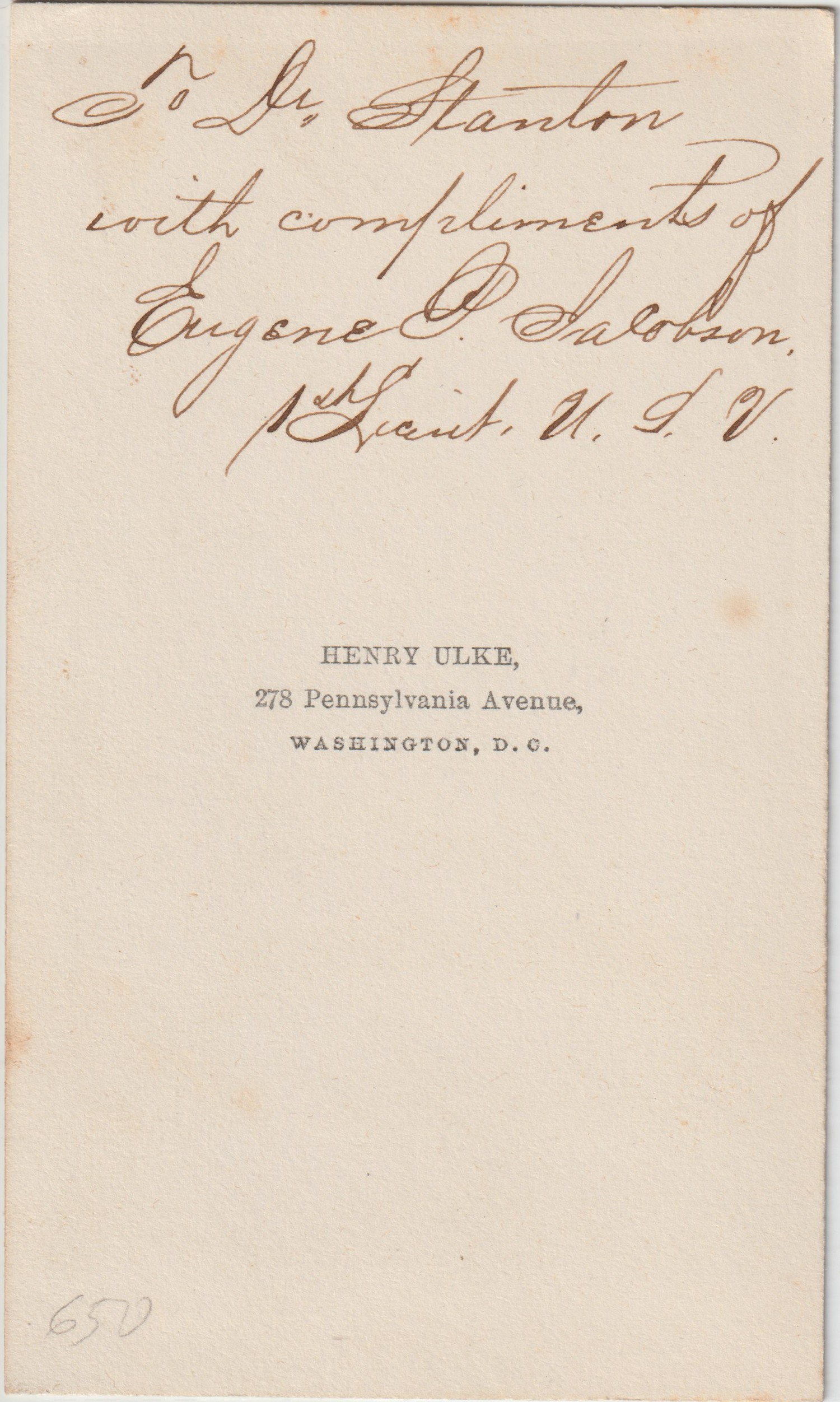
Signed Photo, being a Carte-de-Visite, sepia, duodecimo, undated, taken by Henry Ulke of Washington, D.C. Depicting Jacobson standing in uniform, holding his kepi and wearing a cape. Signed on verso in ink “To Dr. Stanton, with compliments of , Eugene P. Jacobson, 1st Lieut. U. S. V.”