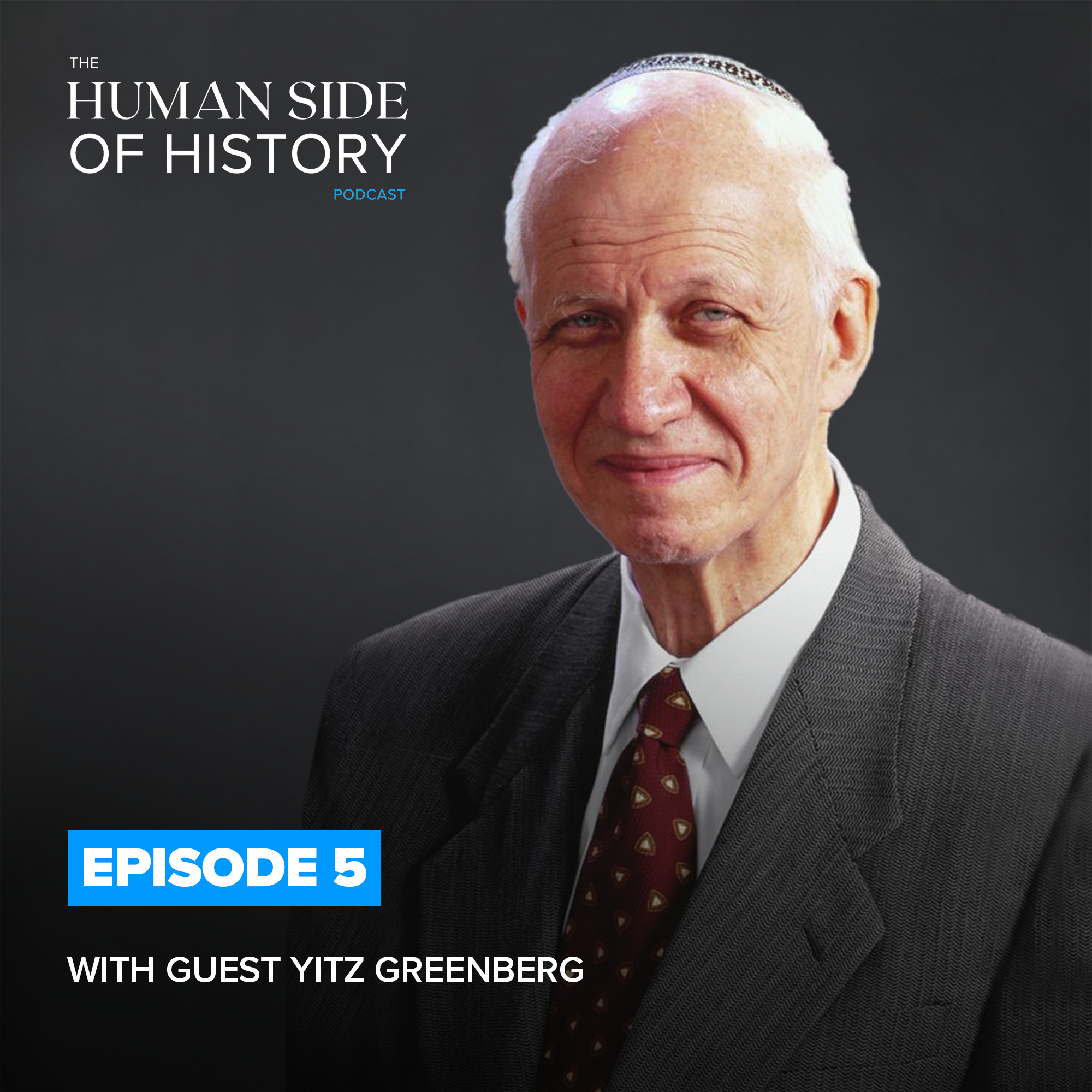
“Unbreakable Bond”: Understanding the Enduring US-Israel Alliance with Guest R. Yitz Greenberg
Runtime: 39:17
Featured Guest: R. Yitz Greenberg
November 19, 2024
What are the historical, cultural, strategic, and values-based foundations that sustain the enduring US-Israel alliance? Host Gil Troy and historian and theologian R. Yitz Greenberg discuss the key factors that underpin, and the historic moments that have shaped the partnership between the United States and Israel.
R. Yitz Greenberg is an American historian, author, and theologian. Known for promoting understanding between Judaism and Christianity, he earned a PhD in American history from Harvard University, was an associate professor of history at Yeshiva University, and a founder, chairman, and professor in the Department of Jewish Studies of the City College of New York. He is currently the Senior Scholar in Residence at Yeshivat Hadar.
Yitz Greenberg
The truth is, the American Israel Alliance represents the best hope of humanity. It was, it’s an alliance that defends our democracy, Western values, human dignity, women’s equality. One could go on and on. It has weaknesses, it has frictions. Nevertheless, if you look at the perspective of history, we have never been this powerful. We’ve never been this well backed by each other. And I believe in fact that whatever the cost, and that’s the most painful part of this moment, Jews are willing to pay that cost. And I believe that the good guys will win because they have that devotion and that dedication to life.
Gil Troy
I’m Gil Troy, and welcome to the Human Side of History podcast, where we discuss how history helps us understand our current moment. In this initial series, we’re going to use history and historical documents from the Shapell Manuscript collection to explore some of the most compelling questions raised at this difficult historical moment, especially since Hamas’s horrific invasion of Israel on October 7th.
And today we want to look at the DNA of the US-Israel relationship. See what’s enduring but also see how it’s evolved what are the catalysts that have made it change. Today, we’re going to talk with a man who wears many, many hats, Rabbi Yitz Greenberg. Who, among other credentials, has a Ph.D. in American history from Harvard University.
But to start, let’s go to the origin story. Let’s think about that remarkable moment in May 1948, just 11 minutes after Israel declared itself a state when president Harry Truman recognized the state of Israel. In November 1947, November 29th, 1947, the United Nations had voted in an extraordinary plan. Everybody likes to call it the Partition Plan, but one of the things I like to emphasize it was that also at that moment that the world community recognized the Jewish rights to the land. So it’s not just the partition plan resolution. It’s also the affirmation of Jewish rights in their formal homeland. Now, the Jews didn’t need that affirmation,. But it was a nice recognition, especially after the horrors of the Holocaust. And it’s actually one of the few countries in the world today that was validated, legitimized, recognized by the United Nations.
So that’s November 29th, 1947. And one of the miracles of that day was that not only the United States voted for the resolution, but the Soviet Union did, too. Now, both were in some ways competing for dominance in the world, and maybe both wanted to win this Jewish state over to their side. But there also was a certain recognition after the Holocaust that this enduring connection that the Jews have to their homeland had to be respected and validated. It was a compromise, and unfortunately within days of that compromise waves of Arabs, start attacking. And the first couple of months after the November 29th, 1947 compromise resolution, over 330 Jews are killed in what’s emerging as a civil war.
And so, by May 1948, Harry Truman is under tremendous pressure. The British were about to leave respecting the resolution. What should the United States do? What should the Jewish people do? David Ben-Gurion, who will become the first prime minister of the State of Israel, makes it very clear we’re going to announce a state as soon as we can. May 14th, 1948. The pressure under Harry Truman not to recognize that state is tremendous. George Marshall, one of the most legendary generals in American history, who’s Truman’s Secretary of state, threatens to quit if Truman does that. Marshall is thinking about over 200 million Arabs and Muslims will be inflamed. He’s thinking about oil interests. He’s thinking about how viable is this weak Jewish state with barely 600,000 people and so many enemies surrounding it.
But Truman ultimately decides to take the plunge. And there are so many reasons. Everybody likes to focus on the fact that he had this Jewish friend, Eddie Jacobson, who approached him. They’d been buddies in the 1920s, and they’d had a haberdashery together. Nobody ever uses the word haberdashery except when they tell this story. Haberdashery means a men’s store. And it went bankrupt. Both Truman and Jacobson were honorable men, and they didn’t run away from their debts. They paid every last creditor, and they were bonded for life. They’d been war buddies also in World War I. And they say, oh, that’s why, because Jacobson went to Harry. He said, I’ve never asked you for a favor before, but meet this man Chaim Weizmann who would become the first president of the state of Israel. But that’s only part of the story, as we’ll hear. It’s 1948, an election year. There are political considerations. Harry Truman is starting to fight the Cold War. There are geo-political considerations. We have to be thinking on so many levels as historians.
So on May 14th, Harry Truman recognizes the state of Israel. On May 17th, Harry Truman writes a letter to a friend of his, a local rabbi, who had sent him a letter on May 13th. On the eve of this difficult decision. And Truman writes,
Dear Rabbi Thurman,
I enjoyed the visit with you very much and appreciated most highly your letter of May 13th. It looks as if the Palestine situation is very dark this morning. Although we recognized the Jewish Free State, as soon as they organized a government and asked us for recognition.
I shall remember your offer of service and expect to make use of it if the going gets any rougher.
Clearly, there was some political backlash. Clearly, Thurman said, I’ve got your back.
So we see that Harry Truman is let’s say, at peace with his decision. And in fact, he will, over the years, become more and more proud of his decision. More and more convinced that it was the right thing to do it was the smart thing to do it was the shrewd thing to do.
Ironically, Truman’s successor, President Dwight D Eisenhower, was not always seen as to be as good a friend to the Jews and Israel. Although this letter from David Ben-Gurion in 1970 suggests otherwise, and hints that maybe there are other forces at work. It’s 1970. David Ben-Gurion, who was the first prime minister and defense minister for many years as well, is now in retirement on a kibbutz in the south called Sde Boker, and a journalist named Virgil Pinkley sends him a letter. He’s writing a book, “Eisenhower Declassified,” a kind of look at Eisenhower because Pinkley had been friends with him as a journalist during World War II and thinks that in 1970 people don’t really appreciate how great a President Dwight Eisenhower was.
Dwight Eisenhower, of course, had been the winning general, the great organizer, who not only was the hero who was bold enough to launch the D-Day invasion, which really changed the course of the war, but also was there throughout keeping the allies together and being the public face of the great American victory in 1945.
I owe to my country much more than my country owes to me, if the country owes me anything at all.
I am glad that you are writing a book about General Eisenhower, he was a lovely person. I met him first in Germany immediately after the Second World War.
I told him that almost all Jewish refugees in Germany intend to settle in Israel.
And they need more education, more self-government, more Hebrew teachers, more Hebrew books. I asked him to send every week an airplane to bring teachers and books. He agreed to everything. But when the first plane arrived, the British administration could not prevent it. But they immediately applied to the Foreign Office, the British Foreign Office and the Foreign Office then went to the State Department, and the State Department ordered Eisenhower to stop sending planes to Palestine.
I had a later chance to talk with him when he was president. I never met a better friend of Jews. He was a lovely person.
Now, what’s going on in this letter? Ben-Gurion is telling us that the British Foreign Office and the State Department is filled with what was called Arabists. People who, like George Marshall, were more concerned with the 200 million Arabs and Muslims and far less concerned with the Jews. Was it antisemitism? Sometimes. Was it their own geopolitical analysis? Sometimes. Was it oil? Sometimes. And so we see that it’s complicated.
Interview (9:12)
Gil Troy
To put all this in historical perspective. And if I know him, theological and ideological perspective too. We turn today to Rabbi Irving Greenberg, known universally and lovingly as Yitz. Rabbi Greenberg is a leading Jewish thinker, a theologian and activist. He’s president of the JJ Greenberg Institute for the Advancement of Jewish Life. He’s senior scholar in residence at Hadar. He’s the author of six books, including For the Sake of Heaven and Earth The New Encounter Between Judaism and Christianity and he’s just released his magnum opus, The Triumph of Life. a narrative of the relationship between God and humanity, as expressed in the Jewish journey through modernity, through the Holocaust, through today’s topic, the creation of the State of Israel and the birth of Judaism’s next era.
But today, we want to put all those credentials aside. We want to go back to one of your first great achievements, which was earning a Ph.D. in American History at Harvard University. Back in the day, I have to add, when Harvard University wasn’t that friendly to young Jewish kids from Brooklyn. So it’s quite remarkable that you were accepted. Quite remarkable that you excelled there. Quite remarkable that you ended up writing a Ph.D. thesis about Theodore Roosevelt under the tutelage of Frederick Merk who was a student of Frederick Jackson Turner and so you’re part of a chain of great American historians who understand the DNA of America. So Yitz let’s go back to that moment in 1948, when within minutes after the establishment of the state of Israel Harry Truman recognizes the Jewish State, they don’t even have the name Israel in the original telegram. What was going on? What was the motivation? What does that teach us about America, about Israel, about the American people and the Jewish people?
Yitz Greenberg
Well, I’ll start by saying it is, was close to miraculous. And it remains really one of the providential moments of Jewish history. And I say that in part because the story is that the British had given up the mandate. They had taken a mandate to help nurture a Jewish national home, but in fact had spent the previous 20 years back working and betraying the mandate and trying to cater to the Arabs who they saw as the future of the Middle East. They wanted to be on their good side. The UN, of course, voted to create two states, Jewish and Arab, out of the, to partition and the land of the mandate, and the Jews accepted it. Nevertheless, there was strong pressure against it, and in fact America, which initially supported this idea, had second thoughts and in fact pressed Ben Gurion and the Jewish leadership not to go ahead and proclaim this state. So the truth was for many years, including after 48, the Arabists, the pro-Arab State Department civil servants who believe that the future of the Middle East was Arab, that the oil was more valuable than the Jews, and therefore America should, as it were, step away from the Jews in order to support, get the Arab support.
Truman partly because he was apparently friends and close to a Jewish partner who gave him a deeper insight into how much Israel meant for the Jewish people and a chance to come back to life after the terrible Holocaust. Partly because Truman was an independent-minded, like a mule from Missouri mule which he often spoke about himself. The bottom line is that he overruled the advice of his State Department and decided to recognize the State of Israel. Now, part of it was that there was a close election. And in New York, where the election might well be decided, there was an important Jewish vote. But whatever the mixture of motives, the amazing bottom line is that America recognizes the state of Israel. And in many ways, had it not led the way, there would have been serious question whether the international community would have stood behind the Jewish people.
Gil Troy
There is something miraculous about the bond between Israel and the United States of America and between, as you say, the Israeli people and the American people. But then you also, as a good trained historian, went into the electoral dynamics because it was 1948 and Truman was trying to emerge out of Franklin Roosevelt’s shadow and win an election with powerful forces, Thomas Dewey and the Republicans against him. It was indeed a geopolitical assessment on his part, where he defied the State Department not just for altruistic reasons, not just because of his good buddy Eddie Jacobson, because he also thought that the State Department was wrong. Let’s go deeper. What are some of these deep, deep connections between the United States and Israel, between the American people and the Jewish people, not just the Israeli people?
Yitz Greenberg
No one could have predicted what has happened, which is America has been the most faithful, powerful and important ally in Israel’s history. But you look back and say, what did they have in common? Why would the America become so supportive and so sympathetic? And I would say it’s a mix of human experience. For example, for example, both the founders of America, that is to say, the Puritans, the early founders of the New England and the northern United States, they fled oppression. And they were willing to go to a new world and take up the difficult, challenging new life in order to win freedom. Freedom of religion, freedom from oppression and human dignity. Well, that’s exactly what drove the Chalutzim, the initial returnees of the Zionist political movement starting in the 18th 19th century. They were driven by the same desire to leave the lands of oppression in Europe, Eastern Europe, particularly where Jews were second class citizens and discriminated against. And were willing to go to a new, across the ocean, go to a new country with sickness and barrenness, and many, many struggles that they had to overcome in order to win their freedom and their dignity as Jews.
Second example would be the Bible, the Puritans and their for their part. And they were they felt they were living the Bible, but also the founding fathers of America who were enlightened and more rational but they also had a very special respect for the Bible. And that sense of a shared Bible has been a very important part of the American people’s feeling and attachment to the Jewish people and to the state of Israel, and so that’s another major element of common feeling and common respect. I’d add to that both peoples really felt a sense of democracy, meaning looking at the Middle East and all the Arab nations, which at the time were totally opposed and willing to destroy Israel, but they were oppressive. They were ruled by dictators, whereas Israel was a democracy very much in the spirit and in the common values of America.
I’d add one more example. After the Holocaust and again during the Holocaust, one of the great tragedies of human, certainly of Jewish history, is that the allies, including America and Franklin D Roosevelt, as good as they were to the Jews domestically. The bottom line was that they abandoned the Jews of Europe. And even though they knew the extent of the destruction, this unbelievable extermination, they really did very little to save or to try to stop the destruction. But after the war, there was a recognition and some guilt and some feeling of failure. And it’s interesting to be looking back when the discussion and the vote on the United Nations again, if you look at a pure realpolitik, why should you vote for a Jewish state? They don’t have others, countries behind them. The Arabs already had tens of votes at the United Nations. They already had major resources of wealth and oil and so on. Why would you stick with the minority, weaker, more vulnerable people? But again, part of it was a sense of recognition, maybe guilt, maybe some compassion. I was struck in the discussions at the U.N., that Andrei Gromyko and the Russians, who were ruthless and totally anti nationalist Jewish and anti Zionist and anti Jewish being different in any way. Nevertheless, Russia ended up supporting the vote.
Don’t forget the Nazis, Eichmann’s famous line when he escaped the first after the war before he was caught eventually. When he escaped he told his coconspirator dit nicht lichnov. Together they had killed, wiped out Hungarian Jewry. Wicht lichen if they catch us, they’ll put us to death. He said, if they catch us, I will jump into my grave laughing, because it’s true I didn’t finish off the last Jews, but they’ll never recover from this death blow which we inflicted upon them. Well of course he was wrong. Israel proved he was wrong. The Jews chose not to lie down and die, not to give up their existence. So I think the world, some by inspiration and some by almost reluctant admission of failure, stood behind Israel in part to allow this incredible response of reasserting life, renewing faith in covenant, renewing a broken land in order to create an outburst of life. A life that I believe expresses the fundamental teaching of Jewish religion. That in this world we’re supposed to live and work on this side of life, and that God as our partner in making this world a place where life wins out over everybody else. So all of that played a major role in linking the Jewish people.
Gil Troy
So what’s so remarkable about your answer is it packed into your answer is a real countercultural sense of the power of the American story and the Jewish story and the Israeli story. And unfortunately, too many historians today, too many academics today don’t have that faith anymore, don’t have the sense in the power of progress. So I really want to thank you for that prose poem and the second letter we read was about, Dwight Eisenhower, where Ben-Gurion, David Ben-Gurion, the first prime minister of the State of Israel, may surprise some people today by saying, oh, Eisenhower was a good friend of the Jews, a good friend of mine. And whether he was saying that just to be politically correct, as we would now say or not, we don’t know. But he does point out that it’s not just the British who are a problem at the very start of the US-Israel relationship, but the Arabists in the State Department. Tell us a little bit about how Israel and America were able to overcome some of their foreign policy experts in the 40s, in the 1950s, so that the relationship could grow, as you’ve said, into this remarkable relationship, this remarkable alliance.
Yitz Greenberg
There was opposition, the strongest, not just in the State Department, for example, in the oil industry. The people who said Arabs have these incredible oil resources, we’re going to need them and let’s go with them and do anything that they ask us to do in order to make sure that they cooperate on our side. So, as you might say, was realpolitik against human value, against the narrative of human dignity and human value. And in this case, as it turned out, the narrative went out. I should add to this that Eisenhower, the administration, gave Israel a hard time at that time.
Gil Troy
Especially around the 1956 Suez Canal crisis.
Yitz Greenberg
Egypt and the Arab League were still, even though they had failed to destroy Israel, were still totally boycotting, totally trying to destroy it and undermine it. And in 1956, Israel joined with France and Britain, which were angry and resentful at Nasser’s seizing the Suez Canal and driving out the Western powers. Israel joined them to invade Egypt and recover the canal. America totally objected. It inserted itself. It literally forced Britain and France to back down, and then Israel, and then it forced Israel to back down and remove its troops. So America was very much on the Arab side in that whole exchange and threatened Israel in all kinds of ways.
Gil Troy
I think we also have to think about the 67 war. A war that seem miraculous, but that also, in many ways brought the United States and Israel ever closer together.
Yitz Greenberg
After 67, when Israel had this miraculous victory, and the world sort of realized that in these 19 years since its founding, it had turned from a almost powerless, unarmed, or certainly short on arms, short on training, no military tradition to a people that had become one of the most effective armies in the Middle East. And, of course, their air force, which wiped out the other air forces and won the battle within a day.
Gil Troy
If we go to 1973 and a low moment of Israeli history, the Yom Kippur War, despite the surprise attack, the American airlift, the support that President Richard Nixon and his senior staffers, including Henry Kissinger, gave to Israel, ended up really changing the relationship.
Yitz Greenberg
Kissinger, the Americans, Nixon and Kissinger on the one hand saw for the first time in this competition in the Cold War, which was the central challenge of American foreign policy, that here is a chance to get Egypt, at least, and maybe more Arab countries to shift sides from Russia to America. And the way to do that was to get Israel to moderate its military victory and to allow the Egyptians and the others face saving and the chance to declare a peace with Israel. So Israel, and it might say, proved at that point what the Pentagon was learning and continued to learn for the next 20 years, that as an ally it wasn’t just something you underwrote and supported it was giving back incredible value. Israel was like a permanent aircraft carrier with American force. American troops could use any time. And America’s allies, in this case Israeli troops, could carry out America’s needs and goals.
Gil Troy
At this moment when so many people are losing faith in Israel and in the US-Israel relationship. You’re, first of all, reminding us, as Harry Truman’s letter to the rabbi just days after the state was established, was that sometimes things were even worse, especially in 48.
Yitz Greenberg
Right.
Gil Troy
That and when we think about how far Israel and the Jewish people have come it’s quite remarkable. When we see the built in power, I love the way you put it it’s the pilrams and the pioneers linked to the bible. And the notion that Israel and the United States are not just among the small group of countries in the world that are democracies, but their also among the even smaller group of democracies in the world that are ideologically driven and that have these biblical values. And so that helps us understand, even during these bleak times, that things might get better. But I have to say listening to you, it’s also kind of depressing to see where the world was in 48 49 back in 47 even when the Russians and the Americans both supported the UN resolution and where the UN and the world is today. But finally finally what yo’re really ending us with is the importance of these catalysts. That yes ideology is important but I think in 1973 after the 73 war, and I love this metaphor as Israel as this standing aircraft carrier not just for the United States but for western values and for democracy and western civilization, that the pragmatic and the ideological came together. And when we look today, when everybody is so busy saying oh the US-Israel relationship has never been so bad it sounds to me that you would actually say oh the US-Israel relationship has never been so good. What’s your assessment of where we’re at and how far we’ve come?
Yitz Greenberg
You know, I’m tempted to answer it was the best of times it was the worst of times. The truth is that the Israeli American alliance has never been as stronger and as powerful as in the last decade. And with all the friction and with all the talk about alienating America, and I don’t want to say there isn’t any of that. The truth is, the Jewish people lived on the margins of history. What the Holocaust showed is that those margins are gone. In other words, we’re living in a world where if you can’t protect yourself, and you’re a potential victim, you will be wiped out because the world has more power. The oppressor has more power, then ever before in history. So in a sense, the Jews had to give up that option of living powerlessness, but ideal. You know, people always say, the Jews we never had an army that killed civilians. We never oppressed others. Well because we didn’t have the power to do so. But I’d say it’s a much more honorable and much more significant moment we take power. And yes if you take power, you will have some side effects that are far from ideal. But we’ve taken power for life, for values.
The truth is, the American Israel Alliance represents the best hope of humanity. It was, it’s an alliance that defends our democracy, Western values, human dignity, women’s equality. One could go on and on. I mean, you think of Hamas and the Palestinians persecution of gay and LGBT people, and Tel Aviv was rated the literally the gay friendliest city in the Middle East and so on. So, this alliance, it has weaknesses it has frictions. And I must say, personally, I feel the present government of Israel with this extremist has done real damage to the trust and respect, mutual respect that is so crucial to our alliance. Nevertheless, if you look at the perspective of history, we have never been this powerful. We’ve never been this well backed by each other. And I believe in fact that whatever the cost, and that’s the most painful part of this moment, Jews are willing to pay that cost. And I believe that the good guys will win because they have that devotion and that dedication to life.
Gil Troy
Well, all we’re hearing is about tensions. All we’re hearing is about distance. And yet, every poll that I read shows that 70% to 80% of the American people, when given a choice between Israel and Hamas, support Israel. Not only that, when they’re asked the follow up question of do you think that Israel is trying to minimize civilian damage? Most recent poll in May 2024 showed 69% of Americans say, yes, we see that. But it’s just very, very difficult under the circumstances. You’re saying that the US-Israel relationship is a triumph of life. The story of the United States of America is a triumph of life. The story of Israel is a triumph of life. And I think that’s your theological vision and that’s your historical vision.
Yitz Greenberg
The truth is, in the 50s, as late as the 50s, Jews were a marginal and still discriminated against group in American minority. From the 60s until really very recently, there was a massive upgrade of minority rights. Of course, the civil rights movement for African-Americans is part of that story. But the Jews moved from the margin and discrimination to becoming, with the Pew Research showed, was the most admired minority. So being a Jew is not a disadvantage or a disability, but it was admired and looked up to. Now as the Jewish people moved into this position by their creativity, by their contribution to American life. And as America came to take the Jews to its heart and embrace them it embraced the country of Israel, A because it was also Jewish and it was so profoundly loved and connected to American Jewry. So, in part, the American Israel Alliance reflects the shift and the embrace of the alliance of Christians and non-Jews with Jews in America itself. That is also a testimony both to the greatness of American culture and to the Jewish ability to measure up and become part of a whole society while maintaining their own distinctive identities. So that’s also part of any assessment that we have to make together.
Gil Troy
Today, it seems that this message of hope that seems to be not just in the Israeli-US DNA, but also in your DNA, is not so popular, especially in the church that you and I once worshiped in, the university. What’s happening with the radical left today? Why is there this powerful negativity and how do we get out of it?
Yitz Greenberg
The fact that the radical left has turned on Israel or turned on the Jews, it’s no accident that there’s an outburst of antisemitism as there’s an outburst of anti-Zionism. Which of course is the same thing anyway. It’s it’s a it’s a kind of turning on the Jews. It’s a kind of turning on the Jewish state, it’s a turning on the values that they represent. But those values, I think, are enduring, and I believe they have overreached. In other words I think the majority of Americans are moderates. They’re not radical left. They believe that capitalism has faults and has to be improved, but they also believe that it’s not the enemy. And it’s not that only Marxism or or extreme socialism is going to solve the problem. That we saw failed in the 20th century.
So I see this as a moment where temporarily, the publicity, the media coverage, the attention has always been on trying to claim that Israel has lost its way, that the American youth is drifting away from Israel. But in fact, I think it’s the media taking up this false narrative in which all whites are oppressors. In which all the people of color, so-called, are automatically oppressed, and anything you do for them is legitimate. Even murder, rape, torture, when of course it’s totally false, and it’s corrupting and it’s destructive for those people. So the truth is, I believe this will fail. And just as Martin Luther King understood when he fought for black rights, that the Jews and Zionism, the state of Israel, is the way the Jews, one of the important ways Jews get their rights and their dignity and their equality. And that’s why he supported it. And he realized that the extremist, the black nationalists, the Stokely Carmichaels who turned to violence and denied the American story and insisted America is totally beyond redemption, that they were actually bad for the people that they were supposedly helping, African-Americans, and that their values were false, and that the future of a bright future, a good future, depended on taking the American story seriously and asking Americans to live up to it, rather than demeaning it and selling it out for the for radical denial stories, as if all American is only about slavery. As if all of America is only about inequality and oppression. So I think the American, the majority of American people are not yet corrupted by this false dichotomy and are not yet ready to follow the lies of intersectionality. For that matter they know the truth, the Palestinians are no more people of color than the Mizrahim of the 50% of Israel that comes from Arab Jewish ancestry.
So I am, I am in the long run optimistic. We have work to do to get the story out. But I do believe in the end, the best American values will win out. That the American narrative will not be permanently falsified and turned into a story of oppression, but rather turned into a true story and a story of improved life, of more dignity, for more people with serious flaws and setbacks along the way and with opposition. Israel is also not a, it’s not a country of saints. It’s not a country of perfection. But with all its flaws, it has made remarkable progress to create a just, decent society, not just for Jews, but for Arabs, for Christians, for Circassians, for Druze, other minorities. And that I believe, in the future we will see the fulfillment of that. And I hope, I believe that this threat will be overcome, and the American people will reassert that they want the moderate center. Even if it takes longer to improve and repair the world, but it avoids the evils of totalitarianism, of discrimination, of anti, of racist anti-racism. And so I hope that in again, Israel and the Jewish people will be a source of blessing, because in defending them and telling their story, we are also defending human dignity and democracy and the best of Western values.
Gil Troy
In 1980, Ronald Reagan was famously dismissive of Jimmy Carter, who was being too negative. And as the avatar of American hope, he said, there you go again, dismissively. I want to say to you, with tremendous respect and tremendous appreciation, there you go again. There you go again, having a clear moral line. There you go again, showing that you can criticize the United States of America. You can criticize the current Israeli government, and yet nevertheless see the good and have the love and have again that triumph of life. And there you go again, reminding us that we can’t just live in the moment, but we have to be transcendent and think bigger. And there you go again, being like Ronald Reagan was, an avatar of hope. And I think that’s also one of the things that brings the two stories together. The United States of America is about the leap of hope, about knowing that tomorrow will be better than today, and rolling up our sleeves and making that happen. And the Israeli story, the Zionist story, Hatikvah, the the Jewish national anthem, is hope. Tomorrow will be better than today and we have to roll up our sleeves and make it happen. And we don’t do it by only being cheerleaders. We do it by being like you thoughtful, critical, moral, visionary, and deeply rooted in our history. A history which in the United States of America is only a matter of just short of 300 years. And when we talk Israel and the story of the Jewish people, we go to 3500 years. I want to thank you Yitz for all that you’ve taught us over the years. I want to thank you for going back to your earliest incarnation as a Harvard historian, and I want to thank you for being such an inspiration to so many of us.
Yitz Greenberg
Thank you. Thank you.
Summary (36:40)
Gil Troy
David Ben-Gurion was proudly, aggressively secular, but he was proudly, aggressively literate in the Bible, literate in Jewish history. And like our guest, Yitz Greenberg, also understood that Providence, bigger forces, mystical forces sometimes were at work. He said, in Israel, in order to be a realist, you must believe in miracles. And I think the conversation with Yitz Greenberg, which went back and forth between thinking about the bigger, deeper existential issues, the miracles, the deep bonds and the nitty gritty, the day to day of 48, of 56 of the Six-Day War in 1967, of 1973, is that balance. And so I think we were so lucky today to have a guide like David Ben-Gurion, a guide like Harry Truman, and a guide like Yitz Greenberg to help us think about the US-Israel relationship, which I sometimes call the good, the bad, and the enduring.
With this episode, we end the first series of The Human Side of History podcast. What we’ve been doing over each episode is taking just a few of the gems from the Shapell Manuscript Foundation and using them to illuminate the moment. And what’s been interesting, is again and again, guest after guest has helped us live with some of the consequences. Live with some of the things that cannot be undone because historians deal with that, but also think bigger, think broader think inspirationally.
As an extra bonus for today, we’ve listed Rabbi Yitz Greenberg’s five favorite books in the show notes. If you want to know more about the Shapell Manuscript Foundation, go on their amazing website and explore. There are so many manuscripts you can find at www.shapell.org that’s one P and two L’s. Also, feel free to visit our show notes for more about the manuscripts, these historic events we’ve described, and some of the bigger issues we were talking about today. And please don’t forget to subscribe to rate and review the podcast. History can determine our future, but it can help us understand the present and make a better future. This is Gill Troy betting on better days.
Check out Yitz Greenberg’s 5 favorite books:
Daniel Ross Goodman, Soloveitchik’s Children
Jacob Milgrom, Leviticus, volume 1
Gil Troy, Why I Am a Zionist
Daniel Kahnemann, Thinking, Fast and Slow
Daniel Gordis, Impossible Takes Longer…
—
Production by docyourstory
Music by Adam Weingrod


A Just Cause & Moral Clarity In War With Guest Michael Oren (Pilot Episode)

National Service & Democracy In Wartime with Guest William Galston
Resilience & Meaning For Soldiers And Their Families with Guest Akiva Harrow

The Origins of the Rise of Antisemitism on American Campuses with Guest Dr. Rachel Fish