
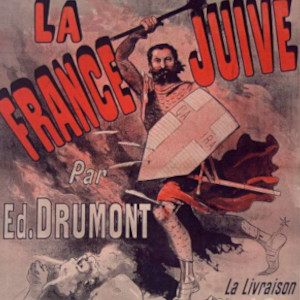
“The prelude to Nazism was played over the entire European stage. The Dreyfus case, therefore, is more than a bizarre, imperfectly solved ‘crime,’ an affair of staff officers disguised by false beards and dark glasses, peddling their stupid forgeries by night in the streets of Paris. Its hero is not Dreyfus but Clemenceau and it begins not with the arrest of a Jewish staff officer but with the Panama scandal.”
Hannah Arendt, The Origins of Totalitarianism, 1951
A Prelude to the 20th Century Antisemitism: Drumont to Dreyfus
The tragic coda that often accompanies the retelling of the Dreyfus Affair is the death of Alfred Dreyfus’s granddaughter, Madeleine Dreyfus Lévy, in Auschwitz in 1944. To the German-American philosopher Hannah Arendt, the violence of the Dreyfus Affair made it seem like a “dress rehearsal” for the Holocaust, though Arendt attaches two important qualifiers. {1} The first is that French and German antisemitism were entirely different animals; the former was a result of the nation-state and did not slide into totalitarianism, a quaint nineteenth-century relic when compared with its German twentieth-century counterpart. The second qualifier according to Arendt was that the conditions for the Dreyfus Affair to take root were laid by an earlier scandal that had rocked the Third French Republic along similar fault lines of religion, politics, and class — the Panama Affair.
Though the Dreyfus Affair originated in France, the impact played out over the entire European stage. The man who did the most to set that stage was undoubtedly a writer-turned-politician Édouard Drumont. {2}
Édouard Drumont’s La France Juive: Rewriting Antisemitism
In 1886, Drumont published La France Juive, a 1200 page invective blaming Jewish people in general for France’s decline, and pillorying many prominent French Jews individually. La France Juive became the most widely-read book in France, selling over 100,000 copies almost instantly. Within the year, the book saw over 100 reprints, and over the course of the next quarter century two hundred editions followed, selling millions of copies.
Amidst France’s culture wars pitting the Ancient Régime–Catholicism, conservatism, monarchism, and nobility–against Republicans–the middle class, Protestants (and Jews), socialists, and secularists–Drumont crafted an intersectional antisemitism. Having recently returned to Catholicism, Drumont emphasized the theological component of anti-Judaic sentiment, going so far as to exhume the medieval trope of blood libels. The religious bled into the economic, with the New Testament story of Jews betraying Jesus for thirty pieces of silver morphing into standard medieval Jewish usury; Drumont updated the classic trope in the form of anticapitalist sentiment that was beginning to emerge by identifying Jews with capitalist wealth.
Modern or “scientific” racism was enjoying a golden age at the turn of the century, and Drumont seized on it to enumerate the biological and intellectual inferiority of the Jews when compared with their “Aryan” counterparts. Drumont’s achievement and popularity was less the creation of a new form of antisemitism, and more about combining its most virulent forms to create not only a more potent antisemitism, but one around which the fracturing body politic could unite. {3}
Drumont Establishes La Libre Parole
The staggering success of Drumont’s screed begat literary as well as financial success. Drumont had enough social clout (and obsession) to establish the Antisemitic League of France three years later, in 1889. More importantly, the enormous financial success of La France Juive enabled Drumont to establish his newspaper, La Libre Parole in 1892. Though Drumont’s paper would gain its runaway notoriety with its incendiary reporting on the Dreyfus case, it was in uncovering the Panama Canal scandal that the paper rose to prominence and both cultivated and sated the public’s taste for antisemitic conspiracy theories amongst its readers.
From Suez to Alsace-Lorraine: France’s Prestige in Crisis
The French had sparked the world’s imagination, wonder, and even envy with the opening of the Suez Canal in November of 1869. The decade-long project was a triumph of modern engineering, a 105 mile passage that lopped 5800 miles off the journey from Western Europe to the Levant and Middle East. Technology afforded the opportunity to deepen economical ties amongst nations through trade, in what was generally seen as one of the “most glorious stages of history.” {4} The man at the center of this breakthrough was not an engineer, but a diplomat named Ferdinand de Lesseps, who had been obsessed with the idea for over three decades.
Less than a year after the Suez Canal’s opening, however, French prestige took a nosedive. The Franco-Prussian War (for which Drumont blamed the Jews) resulted in French military and national humiliation and the cession of Alsace-Lorraine (where Dreyfus was from) to the German Empire. France’s Second Empire crumbled, giving way to a deeply divided Third Republic. Meanwhile, England was quickly eclipsing France as the dominant imperial power in the Middle East, benefitting the most from the Suez Canal, and would occupy Egypt by the early 1880s. France needed a win in the form of economic success and technological prestige. In 1879, the French government tried to repeat the success of the Suez Canal a decade earlier. They trotted out de Lesseps–now 74 years old–to be the face of the ambitious Panama Canal, which was to connect the Pacific and Atlantic oceans. De Lesseps estimated that the project would be much easier than the Suez Canal and would be finished within twelve years — in 1892.
The Panama Affair
The isthmus of Panama proved different and more difficult than creating a canal in Egypt, and as the project encountered more obstacles, the Panama Canal Company was drained of its finances as it crept towards the twelve-year deadline. The company had been financed by the French government, which sold bonds to its citizens, encouraging them to invest in the project as a patriotic but rewarding duty. Facing bankruptcy, the company bribed government officials to allow them to continue the work. When the scandal broke and the company went bankrupt, it took with it the savings of hundreds of thousands of French citizens. De Lesseps, Gustave Eiffel (the engineer who built the locks on the Panama and Suez Canals) and over one hundred other government officials were convicted; over five hundred more were implicated in the Panama scandal.
None of the corrupt politicians were Jewish. The board of the Universelle du Canal Interocéanique did not have any Jewish members, presumably because the French government had terminated Augustin Solomon’s contract with the Colombian government to build the Panama Canal in 1838–thirty years before de Lesseps oversaw the Suez Canal, and forty before the French began the Panama Canal–because he wasn’t “sufficiently Christian.” Yet Drumont and his paper La Libre Parole managed to turn the Panama scandal into a Jewish conspiracy by focusing on the involvement of two Jewish financiers out of hundreds of offenders. In September of 1892, in the earliest days of the scandal, Drumont had published what he called “the Secrets of Panama,” sensationalist stories written by an inside source, revealing the Jewish conspiracy at the center of the Panama scandals. Jacques Reinach and Cornelius Herz were not only Jewish, but German, the perfect scapegoats for the deeply divided French population still licking its wounds from the Franco-Prussian War. Moreover, they played both sides of the political spectrum; Reinach (who had actually served as the government’s secret financial adviser) paid off the right-wing politicians, and Herz distributed the hush money to the left-wing politicians.
Reinach ended up committing suicide to avoid the disgrace, but before doing so, he gave Drumont a list of the corrupt politicians in return for keeping his own name out of the scandal. Naturally, Drumont did no such thing, but the tactical genius lay in how he made use of the list he had obtained from Reinach. Every day, La Libre Parole would publish only a few of the names. All of France was in the grip of Drumont’s paper — the aggrieved general public who were curious to see who was complicit in the scandal, and hundreds of politicians who wondered if or when their name would be published. Ironically, by dragging out the Panama Scandals, Drumont ensured that his paper generated more revenue, thus it was Drumont who financially benefitted more from the scandals than any Jew in France.
Panama Scandal & Drumont’s Jewish Conspiracy Theories
La Libre Parole instantly skyrocketed, reaching a circulation of about 300,000, making it one of the most widely-read papers in the country. {5} The paper focused on Reinach’s, rather than de Lessep’s guilt. It also constantly hammered home the idea that the Jews facilitated the connection between private companies and the state in order to rob the populace and amass wealth. Drumont often strayed from the topic at hand and printed slurs against the tiny Jewish population of France. But one of his baseless accusations seems like an eerie portent of the Dreyfus Affair that would erupt two years later: Jewish officers in the French army regularly bribed superiors for promotions or choice assignments. {6}
Shortly after the Panama Affair, La Libre Parole’s readership declined. Unsurprisingly, however, its circulation soared with its lurid coverage of the Dreyfus Affair. Drumont masterfully set that stage in France by breathing new life into antisemitism and formulating a vision of French fascism that would emerge with the Vichy government some sixty years after he published La France Juive. Drumont was, after all, “perhaps the first radical to call himself a national socialist with all the connotations that have become associated with that term.” {7} In 1886 he had proposed expulsion, confiscation of property, and extermination as solutions to the country’s “Jewish invasion.” Drumont died in 1917, but his legacy lived on in the form of Action Française, one of the first fascist movements of the 20th century and throughout the 1930s and 1940s, where fascist writers developed his ideas and gushed about his influence. The author of La France Juive would have been pleased with Marshal Pétain’s regime; indeed, he helped him get there.